🏈 A season you actually play through
Retro Bowl is New Star Games’ pixel football game about running an offense and managing a franchise. You make personnel choices away from the field, then take charge when your team has possession. Defensive possessions are simulated, so a strong defense supports your career without giving you a second set of tackling controls to learn.
The appeal is the handoff between those jobs. A receiver with useful speed creates a different opportunity from a slower target with reliable hands. A quarterback’s throwing ability shapes the routes you can attempt. Those decisions become visible on the very next drive, rather than disappearing into an abstract team rating.
🎮 Learn one clean pass first
| Action | Desktop input | What to watch |
|---|---|---|
| Aim and throw | Hold and drag the mouse; release to throw | The passing guide and receiver separation |
| Move a runner vertically | W or S | Space above and below the tackle attempt |
| Dive | A | The marker you need to reach |
| Slow the runner | D | Whether a defender is about to overrun you |
| Kick | Mouse clicks on the kicking meters | Power, then direction |
Follow the opening tutorial before improvising. On touchscreens, aiming uses a drag and release, while swipes handle running adjustments. Make your first practice throw a short completion. It is much easier to learn the relationship between the aiming guide and the catch point when the ball does not travel the entire field.
👀 Read a route in two passes
Before the snap
Choose a likely first target and an escape option. Look for the receiver who can cross into open space rather than deciding that your favorite player must get the ball. The route drawing shows where he intends to go; it does not promise that the lane will stay open.
After the snap
Watch the defender nearest your target. If that defender closes the throwing lane, move to the shorter option. A completion that leaves a manageable next down often does more for the drive than a spectacular attempt into traffic.
📋 A third-down example
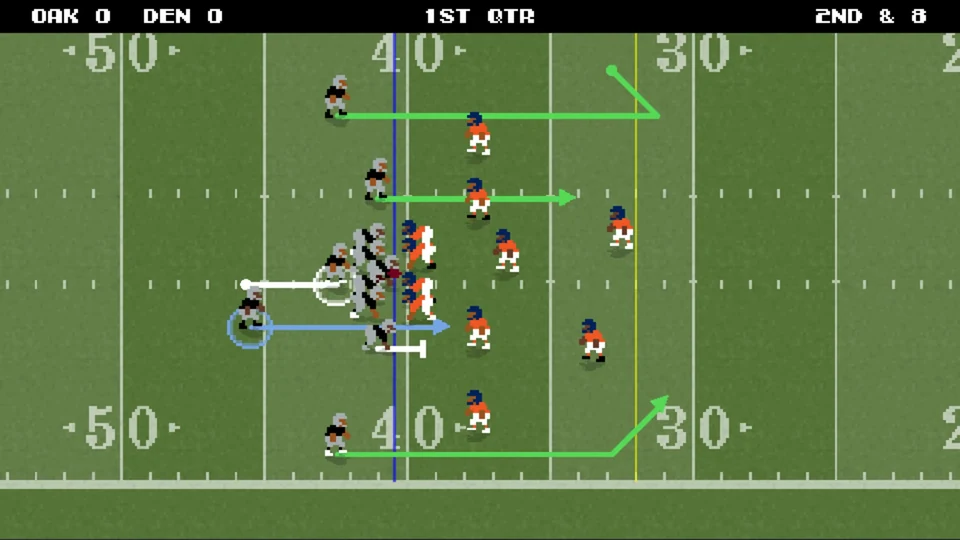
Suppose you need four yards. One receiver is moving deep along the sideline, while a second crosses just beyond the first-down line. The deep play looks exciting, but its defender is staying in position. The crossing route has a small pocket of space.
Try to place the pass into that pocket before it disappears. You are solving the down, not auditioning for a highlight reel. After the catch, decide whether the runner can safely reach the marker or needs a dive. Throwing farther than necessary adds a problem without adding value to this particular situation.
A drive is a sequence of useful decisions. It does not need a touchdown-sized decision on every snap.
⏱️ The same completion can solve two different problems
Imagine the same short route with room after the catch. With a lead and time to use, keeping possession and protecting the ball may be the job. When trailing near the end, the remaining time and the sideline become part of the choice.
This is a tactical comparison, not a claim that a particular route always succeeds. Read the down, distance, clock and defender before the throw. After a failed drive, identify which of those four details you ignored. That is a more useful practice target than deciding every pass must travel farther.
The career-management side should support the actions you can execute. A roster upgrade is only part of the solution if your throwing decisions repeatedly put the ball into a covered lane.
⏱️ Let the scoreboard change your plan
With a lead, the useful question is how to keep possession and avoid giving the opponent an easy extra chance. When trailing late, the same slow drive may become a liability. Read the clock before choosing the next play, especially near the end of a half.
Do not apply “always run” or “always throw deep” as universal rules. A safe completion can move the chains; an incomplete pass can leave time available; a risky interception can end the entire opportunity. Match the decision to the time, field position and points you actually need.
🧰 Build around the plays you can complete
Review the roster after discovering which parts of the offense feel reliable. If every useful route ends before your receiver separates, investigate the receiving options. If accurate short throws are your strength, support that style instead of collecting names with no plan for using them. Keep the salary limit, player condition and the rest of the squad in view when making changes.
The balanced-roster guide offers another way to think about competing needs. For a shorter drafting session after your career game, return to the 17-0 game and make the personnel choices the whole challenge.