🏀 Understand the wobble before chasing the ball
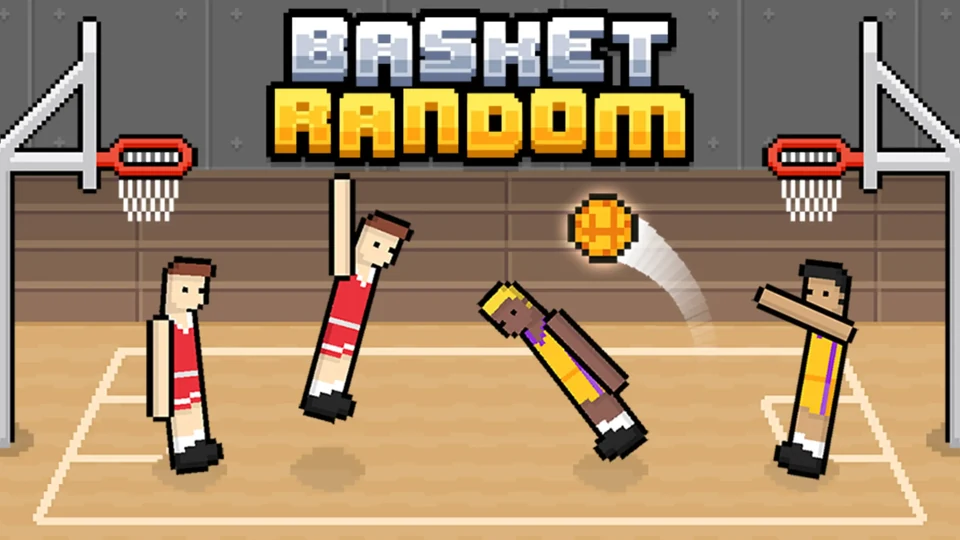
Basket Random is RHM Interactive’s pixel basketball game with two ragdoll players on each team. One input controls your pair, so movement, balance and shooting cannot be separated into a normal sports-game command list. Play against the computer or share a keyboard for a local two-player match.
The target is five points. After a basket, a new setup can alter the court, players, hoops or ball. Treat each restart as a fresh read. A release that worked with long arms and an ordinary ball may behave very differently when the next point brings a heavier ball.
🎨 Read the thing that changed
| Change | What you can observe | Adjustment to try |
|---|---|---|
| Heavy ball | Less bounce and slower travel | Allow for a less lively rebound; avoid assuming the old arc |
| Light ball | A more sensitive bounce | Wait for a readable descent before committing both players |
| Colorful ball | A basket is worth two points | Recheck the score and protect the next possession |
| Different arms or bodies | The reach and balance look unfamiliar | Use the first movement to learn the new contact point |
| Different hoop setup | Height or available opening changes | Aim for the actual rim rather than the previous one |
🧲 Win the second chance
A missed basket does not end the point. If a shot comes down near your own players, an immediate extra jump can send both of them away from the landing spot. Sometimes the better play is to let the bodies settle, then move as the ball enters reach.
Imagine the ball dropping between your front player and the rim. Your back player is still leaning away from the basket. Pressing without looking may launch the pair in an unhelpful direction. Wait for the lean to change, then try to contest the bounce with the player already closest. You cannot independently order the second player to stay home, so read the pair as a connected unit.
🏀 Review the bounce after the first miss
After an unsuccessful shot, watch where the ball lands relative to both bodies. A second jump can help contest it, or carry your pair past the useful contact. The difference is the current lean and the ball’s path, not a longer button combination.
- Was a player already close enough to meet the rebound?
- Did the press send the pair toward that landing point?
- Did a different ball or hoop setup make the previous release misleading?
Try judging one point only by those observations. You can lose that point and still learn something precise about the next release. The changing setup is a reason to read again, not to assume the last successful hold duration is a universal recipe.
🔥 A two-point ball changes the argument
At three points, a colorful-ball basket can finish the match. That is a reason to take the next possession seriously, not a reason to mash the key faster. Watch the opponent’s release and keep a body between the shot and your hoop when the position permits.
When you are behind, the same ball offers a comeback opportunity. Avoid throwing away a useful angle simply because the score feels urgent. The best available shot is still determined by arm position, ball movement and the defender in front of you.
💬 Before the rematch
Does one key mean there is no skill?
No. The skill sits in timing and reading momentum. Fewer buttons make those decisions more visible because there is less room to blame a complicated combination.
Is the two-player mode an online lobby?
The classic game’s two-player option is local: two people share the device. Choose the computer opponent when playing alone.
For a quieter sports puzzle between rematches, visit the 17-0 game. If your interest is the decision rather than the reflex, the pick comparison tool trades a bouncing ball for a deliberate player choice.