The seven-slot Sleeper challenge
What is the 17-0 game?
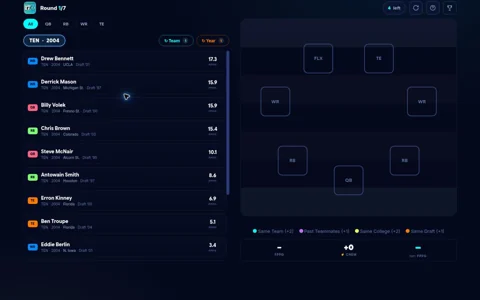
The Sleeper 17-0 game is a seven-pick NFL fantasy football challenge. Each roll gives you a franchise and a season, then you draft one eligible player from that pool. Fill the lineup and the game awards a projected record. Seventeen wins and no losses is the target.
The catch is the season. You might recognize a future Hall of Famer and still be looking at an ordinary fantasy campaign. Read the card’s PPR fantasy points per game (FPPG), then check the chemistry it creates with players already on your roster. The name alone is not the pick.
New to the board? The first-draft walkthrough covers the controls. Below, a finished lineup shows exactly where one real score came from.
One pick per roll
How the NFL 17-0 game works
Roll a team and season
Read both parts of the draw. The player pool belongs to that combination, so a star’s better-known season elsewhere is not an available substitute.
Choose an eligible player
Check which candidates fit your open positions. In the wide game layout, select a player and then choose a highlighted empty slot to confirm the pick.
Check the new total
The selection adds its season FPPG and any counted chemistry it creates. Review the remaining jobs, then make the next roll. Seven committed picks complete the draft.
A narrow play window can use the compact interface even on a computer. Read the team, season and open positions before selecting: a compact-list tap may commit immediately. In the wide field, the highlighted slot is the confirmation step. See compact-layout controls for the differences.
Tap a position to see its eligible destinations. This is a lineup reference; it does not change your live draft.
Know which jobs remain
Seven roster slots, with one flexible opening
You need one quarterback, two running backs, two wide receivers, one tight end and one FLEX. FLEX accepts a running back, receiver or tight end. It cannot replace a missing dedicated QB, RB, WR or TE slot.
If you already have a running back, another is still required. If you have a tight end and an empty FLEX, a second tight end can be eligible. The same card can therefore be useful early and unusable later, depending on what you have filled.
In the wide layout, a strong tight end can go into TE while FLEX stays available for three position types. That is a placement decision to make before confirming. Use the roster eligibility guide for the full map and the FLEX guide for the trade-offs.
Read the labels, not just the record
17-0 game scoring: FPPG plus chemistry
The score has two parts: the FPPG supplied by the seven player seasons, and the chemistry the game recognizes between them. Read both before judging the finished roster.
| Readout | What it means | What to check |
|---|---|---|
| Base FPPG | The sum of the seven selected player-season values. | The season output on each selected card. |
| Chemistry | The team bonus earned through recognized player pairs. | The connection labels shown in the breakdown. |
| Total FPPG | The base production plus counted chemistry.Team FPPG. | The displayed combined score. |
| Projected record | The record assigned to the completed score. | The result attached to the completed lineup. |
- Same Team
- +2
- Past Teammates
- +1
- Same College
- +2
- Same Draft
- +1
A connection applies to both players in the pair. One +2 link therefore adds four team chemistry points when fully counted. Elite and Legendary labels identify designated special duos; a famous partnership does not earn one just because you expect it to. Check the actual breakdown in the chemistry guide.
The projected record is the result of this fantasy challenge. It is not proof that seven players would beat a real NFL schedule. Use the scoring reference to read the labels, then use the completed draft below to follow an actual total.
A real completed draft
How this lineup reached 117.2 Team FPPG
This lineup finished 10–7. Every number below is visible in the accompanying screenshots: seven season entries, four recognized pairs, and the result. Notice Marshall Faulk’s 12.9 FPPG. A great career does not turn every season card into a great fantasy pick.
| Slot | Selected player | Season FPPG |
|---|---|---|
| QB | Daniel Jones | 16.5 |
| RB | Nick Chubb | 15.9 |
| RB | Marshall Faulk | 12.9 |
| WR | Steve Johnson | 15.5 |
| WR | Marques Colston | 15.2 |
| TE | Mark Andrews | 12.4 |
| FLEX | Saquon Barkley | 18.8 |
| Base total | 107.2 | |
What made up this score?
Where the extra ten points came from
Barkley and Jones received a Same Team connection worth +2 to each player: four team points. Barkley–Andrews, Barkley–Chubb and Andrews–Chubb each received a +1 Same Draft connection to both players: two team points per pair.
That is 4 + 2 + 2 + 2 = 10 chemistry. Add it to the 107.2 base and the displayed total becomes 117.2. The chemistry reference explains how to read the other recognized connection types.
What this result helps you review
The links improved this roster’s total, but they did not turn it into a perfect-record lineup. That is a useful distinction when a colorful connection makes a modest player season look irresistible.
A finished list also leaves out the alternatives offered during the draft. It cannot prove which earlier selection should have changed. Record the candidate you passed on while the board is still visible, then use the pick comparison tool to compare the actual point gains.
Two different resources
Spend the reroll that changes the right thing
The two rerolls solve different problems. Each is available once per draft, so first identify which part of the offer you want to preserve.
🎰 Team reroll
Changes the franchise and keeps the season. Use it when that season still interests you but the current franchise’s usable players offer too little for your open jobs.
📅 Season reroll
Changes the season and keeps the franchise. The button is labeled Year in the game. Use it when you want another season from the team already on the board.
A reroll is not a request for a particular player. Before spending it, name a usable current option and the kind of improvement you are looking for. The reroll decision guide works through the harder early- and late-draft cases.
Try three quick decisions
Check your next 17-0 draft choice
These short exercises use the same roster and resource rules. Choose an answer to see the reason.
TE and FLEX are both empty
In the wide game layout, you have chosen a tight end. Which destination leaves more position types available for a later pick?
Choose a destination.
You want to keep the franchise
The team interests you, but the offered season has little that fits. Which reroll looks for another season from the same team?
Choose a reroll.
A link or more base FPPG?
A receiver offers 16 FPPG and one new +2 pair. Another offers 18 FPPG with no new links. If the pair bonus counts in full, which pick adds more team points?
Compare the whole addition.
Choose the question your board raised
Go deeper into your 17-0 lineup
Judge the offered season, available slot and useful connections.
Compare the player you take with the usable option you decline.
Work backward from the positions you still have to fill.
Find the draft decision worth checking before another run.
Before you start or restart
17-0 game questions
Can you go 17-0 in this game?
Yes. The 17-0 game can award an unbeaten projected record when the completed FPPG-plus-chemistry total is high enough. That is the target, but a famous lineup or a few strong links do not guarantee it. The perfect-record guide explains what you can control during a draft.
Can a quarterback go in FLEX?
No. FLEX accepts a running back, wide receiver or tight end. You have one dedicated QB opening. A second quarterback cannot fill another position, regardless of his FPPG. The position map shows every legal destination.
Can I move a selected player to another slot?
Some roster layouts provide movement between eligible slots. A filled field card may instead highlight chemistry when selected. Use the control offered by your screen and choose the initial destination carefully. Moving an existing player is separate from replacing him or reopening an earlier pool; the rules guide covers that distinction.
Do I need to connect a Sleeper username?
The username field is optional for the basic draft. You can read the board, choose players and view the completed result without connecting one.
Why can’t I start another run?
The game has its own remaining-plays meter. If the allowance is used up, follow the waiting information shown in the game. Reloading the play window does not add another play.
What should I do if the game window is blank?
Press Play once and allow the game to load. Try Theater for more room. If it remains blank, the 17-0 loading checklist helps separate a connection problem from a browser setting.